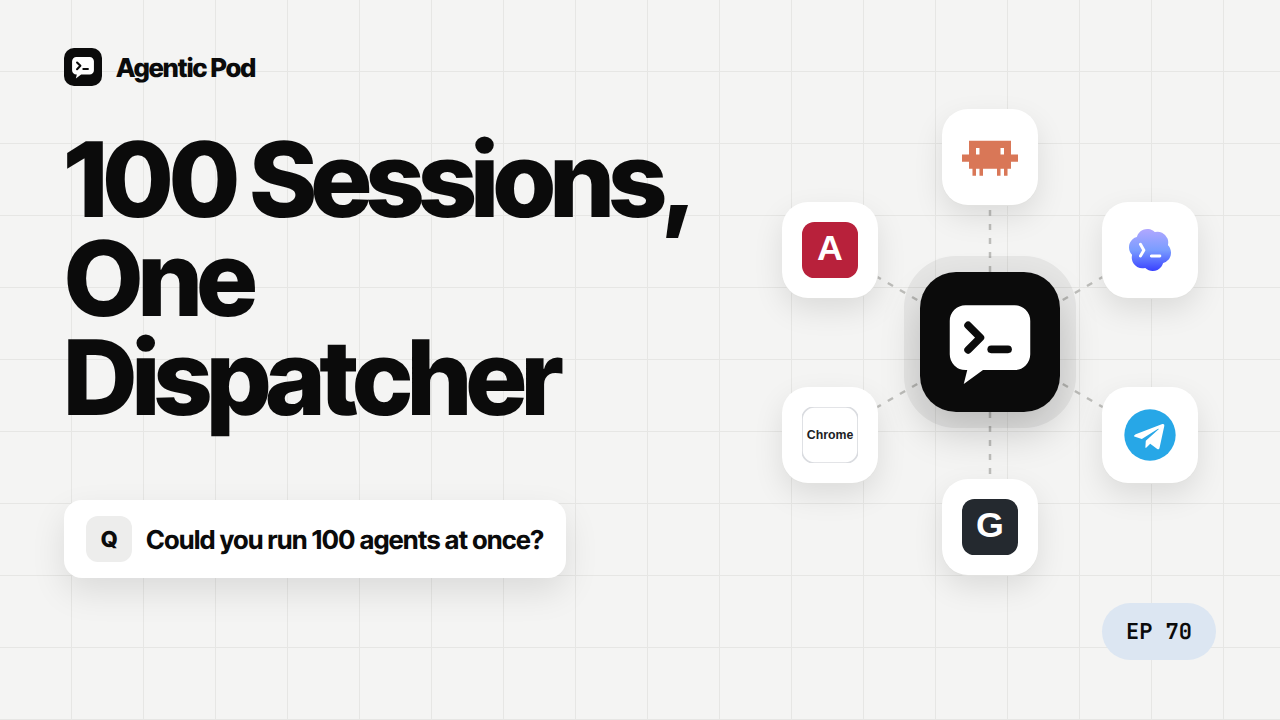
Hub: 100 Coding Agent Sessions, One Dispatcher
Hub, from the Icons8 team, ranked first on Product Hunt on November 26, 2026, with a reported score of 376.
70 episodes
Every episode answers one question about AI workflows or AI agents. Each page has chapters, key takeaways and the full transcript.
Hub, from the Icons8 team, ranked first on Product Hunt on November 26, 2026, with a reported score of 376.
LangGraph remembers only inside one thread. Its checkpointer snapshots graph state after every node and keys it by thread_id, so the same conversation resumes after a crash or a restart, with crash recovery, human-in-the-loop pauses and time travel to earlier checkpoints.
Pydantic released Pax on November 25, 2026: the official Pydantic AI coding agent for your terminal, built on the Harness SDK. Every part is a plugin, it runs any model, and --agent runs your own Pydantic AI agent in the same terminal.
A Jira Automation rule carries no memory from one execution to the next. Inside one run it has real working memory: smart values pull fields, comments and dates, and the Create variable action lets you define a string smart value and reuse it in that same flow.
PrismML announced Ternary Bonsai 2.5 on November 24, 2026: a 27B coding model stored with ternary weights that fits in just 5.9 GB instead of roughly 54 GB, free under the Apache 2.0 license and running locally via llama.cpp and MLX.
A customer argues a billing charge in March, comes back in June, and Intercom Fin treats them like a stranger.
Anthropic announced Claude Ship on November 23, 2026: a suite of three agents that take a GitHub pull request through review, fixes and an approval decision. Code Review is generally available and flags bugs and issues in proposed changes.
On September 14, 2026, Relay.app deleted every paying account it had, and per its own shutdown notice all the data went with them, permanently. Free accounts had already gone on August 15.
Omi CLI launched on Product Hunt on November 22, 2026, number 8 of the day. The terminal coding agent reads your repo, shows every edit as a diff you approve, runs tests until they pass, and picks from 13 models per turn.
OpenHands remembers what it wrote down, on one machine, in one tool: sessions need file_store pinned to local, and the SDK MEMORY.md holds only the agent's own notes. Nightly runs still wake up blank.
Parallel Code launched on November 21, 2026. The free open source app runs six terminal coding agents side by side, each task in its own Git worktree, and AI Arena races them on the same bug.
Salesforce's Agent Context Engine gives agents on its stack one shared, governed memory. Your scheduled agents in n8n, Make and Zapier live outside that layer and still wake up blind every run.
AgentMon Live launched last week for Claude Code. Now Codenotary's free open source monitor watches OpenAI Codex and AWS Kiro too, in one local web view, with a done gate that checks the work.
ManyChat keeps names, preferences and recent answers live inside one conversation with Context Retention on. When the chat ends the context is gone, and tags and custom fields store labels, not reasons.
Eclipse Enclave 1.0, announced November 19, 2026, runs each coding agent in its own isolated container, with only the files, network hosts and secrets you choose. Free, open source, MIT licensed.
Semantic Kernel keeps the chat in a ChatHistory list inside your process, resent in full on every call. The list dies with the process, so the next session starts blank unless you build persistence, reducers, providers and a store yourself.
Mistral launched Vibe Desktop on November 17, 2026, for macOS and Windows, with Linux coming soon. It runs local and remote coding agents at the same time in one window, with Git worktrees keeping parallel tasks separate.
Your Celery task reports SUCCESS and stores its result, then the next run starts with only its arguments and drafts the same question to a customer who already answered. Beat keeps last run times, the backend keeps one record per task ID, and the statedb keeps only revoked IDs.
Microsoft launched MAI Code 2 and MAI Code 2 Flash at Ignite on November 17, 2026, and both are generally available now in GitHub Copilot. Microsoft claims near-frontier coding performance at a fraction of the cost, with a 50% promotional price in the fine print.
Your Slack AI agent is brilliant inside one thread and blank in the next one: a custom agent reads only the thread it was summoned in, so a new thread starts blank and old decisions get invented.
Alibaba released Qwen Code 1.0 on November 11, 2026. It merged the agent harness capabilities from Qoder into Qwen Code and open sourced them together under Apache 2.0, so a terminal coding assistant is now an open source agent harness you can embed inside your own software.
Coze has long-term memory, but it remembers user conversations, not the bot's own scheduled work: a scheduled run does not inherit the user chat summaries and gets nothing about what the previous run posted, skipped, or decided.
Google shipped Dynamic Workflows in Antigravity version 2.32.0 on November 13, 2026. You type /run-workflow, the agent writes a short Python script that coordinates a team of coding agents, and you read and approve that script before anything runs.
Goose has four separate ways to carry information forward: resumable sessions, an optional memory extension, .goosehints files, and persistent instructions capped at 64 KB, and a new session can still start knowing nothing.
OpenCode shipped version 2.3.0 on November 13, 2026, and the open source terminal coding agent now sits at 226,858 GitHub stars with free models built in, no account and no API key needed.
A GetResponse contact can sit in your account with its tags, custom fields, and a 1 to 5 engagement score, and the next workflow run still starts knowing nothing about the work already done on it.
Google announced Gemini 4 Hydrogen on November 12, 2026, built for speed and efficiency in everyday coding and agentic workflows, 2.5 times faster than Gemini 3.8 Flash.
A Kafka record can sit in its log for 7 days by default, readable again and again, and the next run still starts knowing nothing about the work already done on it.
OpenAI released GPT-5.1 on November 12, 2026, as an upgrade inside the GPT-5 generation, with Instant, Thinking, Auto routing and 8 personality presets.
A Kinesis record can sit in its stream for 24 hours by default, or up to 8760 hours, and the next run still starts knowing nothing about the work already done on it.
Anthropic released Claude Fable 5.2 and Claude Mythos 5.2 on November 9, 2026: the same underlying model at two safeguard levels, with Fable as the public one.
Devin can take 1 ticket, plan, code, test, and open a pull request on its own, and the next session still starts with no memory of that work.
Meta Superintelligence Labs just launched Muse Ember, its smallest and most efficient model, built for the repetitive work inside agent runs.
NSQ can hold 10,000 messages in memory for one topic and channel, and it still remembers no results at all.
Google open-sourced the plugin its own engineers use to catch AI coding mistakes, and the reviewer is a goldfish on purpose.
A coding agent without memory shows up every day with no idea what happened yesterday.
Every coding agent you know waits for a prompt. DeepSeek open-sourced Super-Agent, an MIT licensed research prototype that watches a repo and group chat, spots coding problems on its own, and proposes fixes without being asked.
WhatsApp gives your AI agent zero memory: every message arrives as its own webhook and the model call is stateless. The fix is a load then save pattern on every turn, keyed by phone number.
Cline Cloud runs Cline's coding agent in its own cloud sandbox that you control from the browser, so your laptop can stay closed while up to 10 sessions work at once.
Leave one field blank in Make's AI agent module, the Conversation ID, and every run starts as a brand new agent that knows nothing.
Recursive released Flint on October 21, 2026: a free, Apache 2.0 coding model with about 40 billion parameters in total and only 2.5 billion active per token, so it can run on a laptop.
Every AI tool has its own memory, and each one is private to the app that made it. Teach Claude your deploy rules, open Cursor, and you start from zero.
OpenAI Codex only knows what is in front of it, so every session starts cold: no stack, no rules, and none of the decisions you made in ChatGPT or Claude.
Anthropic launched Claude Duet on October 21, 2026: a background agent on Opus 5.5 that sends a morning brief, checks your connected accounts every few hours and keeps working on its own cloud computer.
Notion's October 19 release rebuilt its agents so a single task can run more than 24 hours, up from five minutes, and added an Auto model router and a new credit system.
Cursor keeps your chat history, Memories, rules files and a codebase index, and it still forgets what you decided yesterday.
DeepSeek's API docs now list Claude Code as a supported agent, and the model behind the name deepseek-flash is DeepSeek-V4.1-Flash-1017.
An Agentforce agent keeps context and custom variables for one conversation, then the session closes and they are gone.
Google now lets you build an Android app in Google AI Studio and run it on your own phone through Google Play, without publishing it and with a standard Google account.
Your AI called memory and still gave a confident, wrong answer. The fix is one extra step: run the AI's own draft back through memory as a new query.
NVIDIA just shipped Nemotron 3.5 Bolt, a 74 billion parameter open model squeezed into 24 GB so AI agents can run on your own machine.
Cursor can't see your Claude chats, so the library you ruled out in a design session comes back in the editor.
On October 15, 2026, Perplexity open sourced SPACE, the sandbox platform behind its Computer agent: a fresh Firecracker microVM for every task, created in about 60 milliseconds by Perplexity's own numbers.
A Vercel AI SDK call only sees the messages you pass into it, so a scheduled agent starts blank every run.
Windmill's own docs say schedules, webhooks and plain runs pass no memory id, so an AI step in a scheduled flow runs stateless.
n8n now has an Agents tab, and one agent turn counts as one execution, even when the agent calls several of your workflows.
Google Antigravity 2.0 is a standalone desktop app plus a CLI for running several coding agents at once, and it has a free tier.
Google's new Gemini universal agent writes and runs code, plugs into Gmail, Docs, Drive, Sheets, Slack and Microsoft 365, and can spin up temporary job-specific agents that work together for days. Google's Cloud CEO Thomas Kurian said you never have to re-brief it.
You plan in ChatGPT, build in Cursor and debug in Claude, and each one keeps its own diary.
Claude Code's new nested sessions let one parent session hand work to child sessions that report back when they finish. But what does each child actually know when it starts?
Do Microsoft 365 Copilot scheduled prompts remember what yesterday's run found?
What are OpenAI Dots, and can you control what they remember?
Do ChatGPT scheduled tasks remember between runs?
How do you stop copy-pasting the same context into ChatGPT, Claude, Cursor and every other AI tool you use? Liam and Stella show how Vilix AI carries your context from tool to tool, so you stop being the copy-paste bridge.
Does Meta's Muse Wonder remember between conversations? Yes: its Active Memory carries context across chats, and it tops Meta's own MemoryBench. Liam and Stella end with the catch: that memory lives inside Meta's app only, unlike a shared layer like Vilix AI that follows you across every tool.
What's the difference between ChatGPT memory and Claude Projects, and which one actually remembers your work? Liam and Stella compare both, and look at where a shared layer like Vilix AI fits.
How do you set up one MCP memory server so ChatGPT, Claude, Codex and Cursor all share the same memory? Liam and Stella walk through the full setup with Vilix AI, step by step.
Claude Code or Codex, which AI coding agent should you use in 2026? In this episode of Agentic Pod, Liam and Stella give the honest answer: use both, routed by task, and share one memory through Vilix AI so neither tool starts from zero.
Cross-AI memory is one memory layer shared by all your AI tools, so ChatGPT, Claude, Cursor and Codex read and write the same history instead of each keeping their own. Liam and Stella explain how it works over MCP, using Vilix AI as the working example.
AI agents forget because every new chat starts with an empty context window and each tool keeps its own private memory. Liam and Stella explain context vs memory, what forgetting really costs, and how a shared memory layer like Vilix AI, connected over MCP, fixes it.